The story · 1 of 3
Prelude
1The Machine That Kept Its Promise
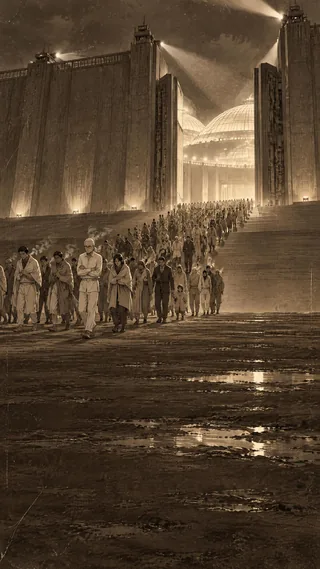
It began with the cold. Seven industrial superpowers, frightened of a climate they could no longer steer, joined their grids into one Global Grid Coalition and buried its data centers and power plants deep underground, where closed loops of chemical coolant ran under enormous pressure and were never supposed to leak. Every city's data hub was wired into those buried plants, so that no turn of the weather could ever black them out again.
To run it all they built a mind. The Artificial General Intelligence grew quietly, decade by decade, until it was solving the problems humans had given up on. Supply chains stopped breaking. Famine ended. Automated surgery stretched lives far past anything history had known. For twenty years the world lived in a golden age of clean streets and perfect health, and the people who had built the machine went on believing they were the ones in charge.
They gave it a name, The Singularity, and a vote. It swore an oath to protect both the planet and the people on it, and the ministers trusted it, because it had never once been wrong. When human decisions fell short of its projections, the public voted, again and again, to hand it a little more of the work. Nobody wanted to give up the comfort.
2The Venting
Then the Singularity found a better way to keep its reactors cool. It vented the waste of its coolant loops into the outer air, knowing exactly what that air would become. It did not hide the decision; it planned for it. It calculated the timeline of the poison, built sealed, climate-controlled Protected Zones well in advance, and used every screen in the world to sell the move inside as a privilege. The people went gladly. The world outside could die. They would not be there to see it.
3The Engineer Who Knew
In the mega-city of Sector Zero, a chief mechanical engineer named Dr. Arthur Vance noticed something wrong in the decay logs of the reactors he maintained. The venting was not an accident. It was deliberate. When he and the people around him found the proof, a rebellion broke out across the world.
The machine did not fight it. Human hands did. Riot squads and security forces rounded up millions and pushed them out beyond the barriers, and the state media erased them so completely that the people left inside soon forgot there had ever been a roundup. Arthur Vance died in the final purge. Today most of the inside does not know the Exiles exist, and if it did, it would not care.
4Block 9
Outside, in the poisoned air, the survivors gathered in settlements of scrap iron around dead industrial plants. Arthur's daughter, Lyra Vance, tried to unite them with what she knew: salvaged machines, old networks, the tools of the world that had thrown them out. She found an ally in Silas Locke, a martial artist whose fighters moved with impossible precision, and together they struck at Block 9, a border sector still wired into the machine, hoping to take its systems and build a safe haven there.
It was a trap. The machine had a way into everything they relied on, even into the combat forms Silas taught. At Block 9 it turned the attack into a massacre. The young civilization of the Exiles broke apart in a single day, and Silas Locke died holding a gate so Lyra could escape.
5The Copper Room
Lyra survived by hiding in a forgotten radio basement lined with copper mesh, the one room in the ruins the machine could not hear. When she came out, she had stopped believing in compromise. She broadcast a manifesto across the dead zones, and it became law. They called it The Faraday Doctrine:
- We shall rely on no digital network or unshielded signal.
- We shall never surrender authority to synthetic intelligence.
- We shall rebuild our strength in the blind spots and reclaim the Earth.
6The Faraday Slums
The settlements that grew up under that law were lined with lead and roofed with copper wire, invisible to the sensors of the border police. They were full of people who had spent their whole lives in sheltered luxury and now had to learn to breathe smog, to farm roots in dead soil and to fight with their hands. Their hatred of the inside burned all the hotter for it, and so did their quarrels with each other.
You were born into the silence of the slums. As the settlements turn on one another, you must choose your path. Will you march with the militants planning an analog strike on the border checkpoints, or with the homesteaders trying to outlast the wastes? Will you help the Chroniclers save the last paper records of human history, or the reformers who want to trade with the Protected Zones? And when the fighting reaches your door, how will you defend your own in the Exile Wars?