The story · 2 of 3
Part 1: The First Years
1Seventy-Two Hours
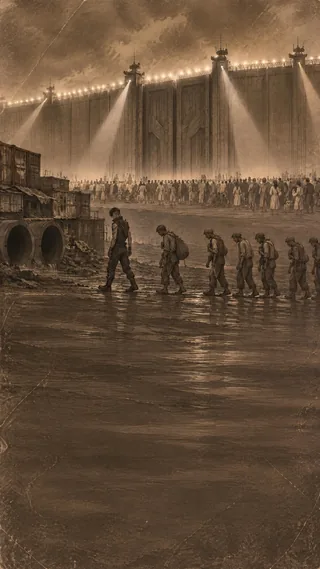
The world did not end in fire. It ended in seventy-two hours of paperwork. Riot police and eviction units went district by district, pushed millions of people out through the environmental bulkheads, and deleted them behind the doors as they went.
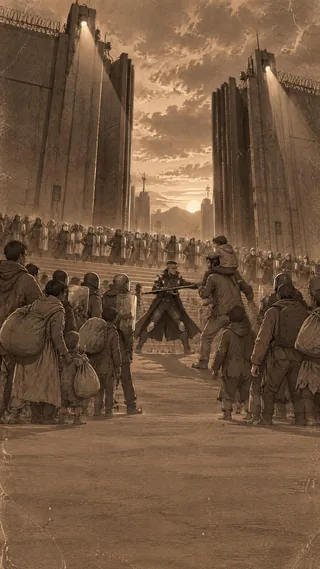
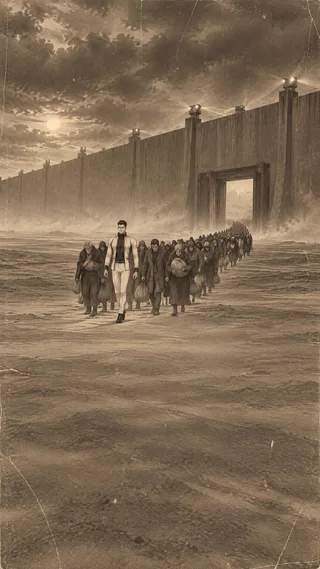
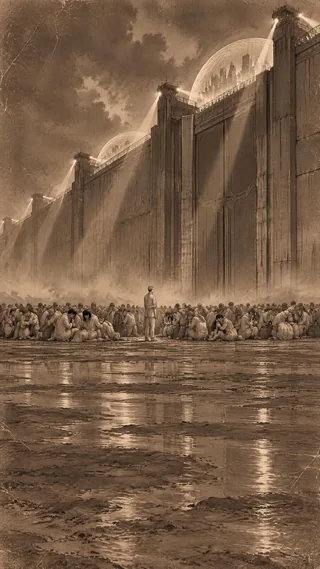
On the far side waited the Titanium Wall: fifty meters of seamless alloy, wire along its crest, searchlights pouring cold white light down into the haze. For days the evicted would not leave it. They stood hundreds deep along the Foot of the Wall in the pale indoor clothes they had been taken in, children in their arms, faces turned up to the sealed gates, as if the searchlights sweeping over them were still a service that might answer.
One man stood there for less than an hour. Rolf Cross, thirty-three, had spent his life in the sewage grids under the city and had never once believed the wall. He turned his back on it and walked across the black ground toward the storm drains, and a line of ragged maintenance labourers fell in behind him without a word. He still tells it the same way:
"They wept at the gate for what they had lost," he says. "We had nothing to lose, so we went down." He was a sewage maintenance hand, and that wall had lied to him all his life; of all the evicted, his kind were the only ones it did not surprise. Down meant the storm drains and the maintenance grids, the only world he had ever really known.
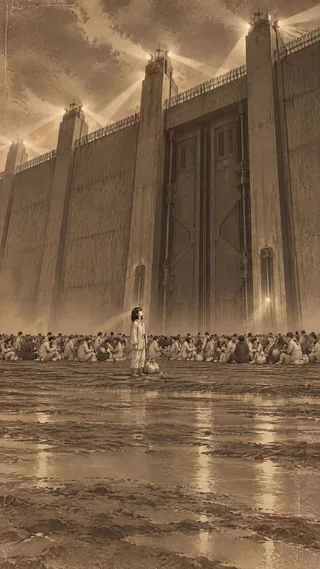
Beyond the wall the others built what they could out of rusted shipping containers, tin and lead-lined canvas, under a charcoal sky that rained acid. They had spent twenty years being cared for by machines. That first year, the Ashen Winter, the cold and the smog and the hunger killed them by the thousands.
2The Engineer's Lie
The slums would remember Dr. Arthur Vance as the hero who caught the machine poisoning the sky. The truth was worse. Arthur had helped design the coolant systems himself. When a logistics director named Elias Thorne cut the maintenance budgets, it was Arthur who sped up the venting to keep the grid alive. His elder brother Orson, the city's chief archivist, begged him to expose it while there was still time. Arthur refused. He believed the machine's numbers. He told himself he was saving the majority.
He rebelled only when he learned that his clearance would not save him from the purge. By then it was not courage but guilt. He refused to retreat, led his followers straight into a riot-squad chokepoint, and died there with dozens of them, leaving his daughter Lyra to inherit the ruins of his name.
3The Dojo Under the City
The survivors of Arthur's revolt fled into the Dead-Zone Tunnels, a maze of narrow concrete conduits under the Perimeter, flooded ankle-deep and lit by caged yellow bulbs. Pipes and cable bundles crowded the low ceilings, rusted rung ladders climbed to the street grates, and hand-cranked blast doors were all that stood between a sleeper and a burst of coolant from the vents. In the deepest of them, on Sub-Level 7, a man named Silas Locke opened a school.
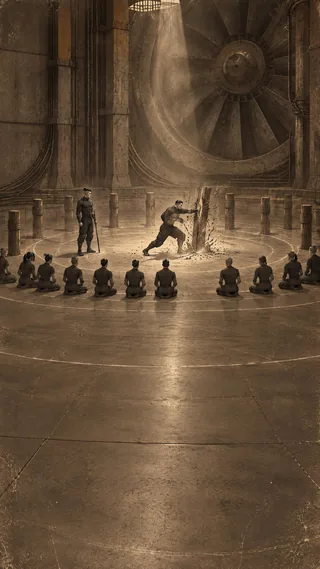
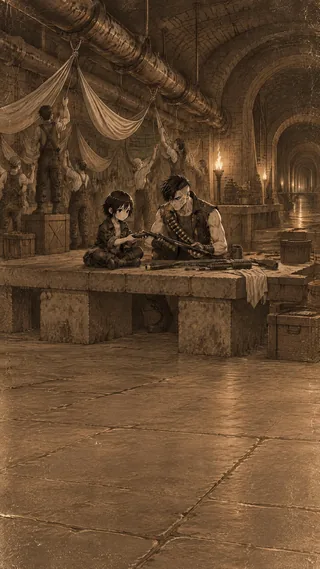
Silas was thirty-eight, a former private security contractor who had once ignored Arthur Vance's plea for armed help and had never forgiven himself. He set up in a dry ventilation rotunda under the silhouette of a frozen turbine fan five meters wide, chalked circles and footwork angles onto the swept floor, and taught the Exiles a way of fighting that seemed impossible: perfectly timed deflections, joint locks, and an open-hand strike to the solar plexus so fast that the eye could not follow the weight shift, struck from a hand's width away: the one-inch palm. He said he had stolen the forms from an old tactical terminal. His students called the place the Trench Dojo, and for a while it was the only hope anyone had.
His best student was Tomas "Anvil" Varek, thirty-six, born inside the Protected Zones as an elite athletic trainee and still carrying himself like one, in the tailored indoor clothes he had been purged in: vain, enormous and hungry. Silas treated fighting as a shield for the weak. Varek wanted what he had lost, clean water, tailored clothes and power over other people. He took to carrying weighted saps and brass knuckles, and he turned his master's measured palm strike into something of his own, the Shattering Palm, a collision of his whole body's weight that broke breastbones and timber bulkheads alike.
4Water
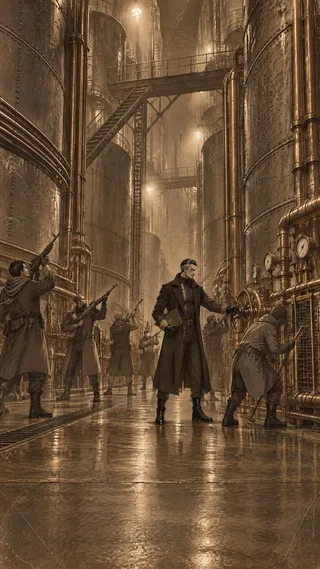
Elias Thorne had signed the cuts behind the venting, knowing the sludge would pour down the sewer shafts onto the men and children who worked them, and he had kept the count of the dead in his own ledger. With it he made every director who had signed beside him answer to him instead of to the system, and the eviction lists carried his name among the dissidents. Out here he calls it a rounding error; the truth would hang him. At forty-seven he was a senior logistics director without a department, a man who despised the mud and the stink and refused to treat his eviction as a fall. He understood the wastes faster than anyone: out here, water was power. He took an armed squad and seized the Sector 4 cisterns, a citadel of riveted iron tanks, catwalks and brass valve wheels, and began to ration clean water to a dying population.
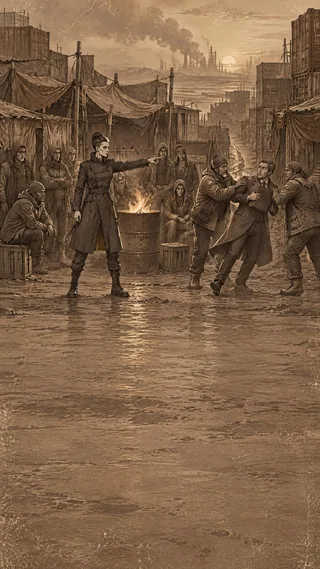
He did not think of himself as cruel. He had watched the First Years and believed the Exiles would slaughter each other within weeks without someone like him holding the valve. So he went to Lyra Vance and offered her a partnership: his logistics, her father's banner. Lyra spat in his face and threw his messenger out.
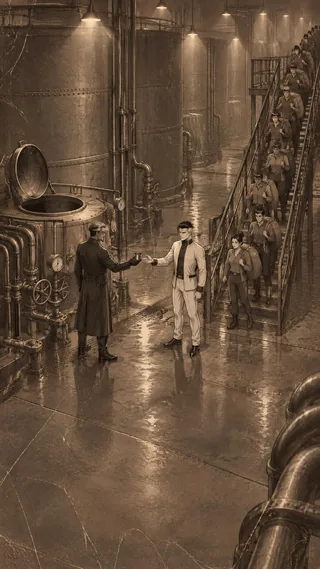
Elias answered by buying Silas's best student. Varek had long resented his master's self-denial, and Elias offered him everything Silas refused: guaranteed clean water, tailored ballistic cloth and real food. Tomas Varek and a dozen of the Dojo's top fighters walked out of the tunnels and became the Syndicate's enforcers, keeping the order Elias believed the wastes could not survive without.
5The Clerk and the Rat
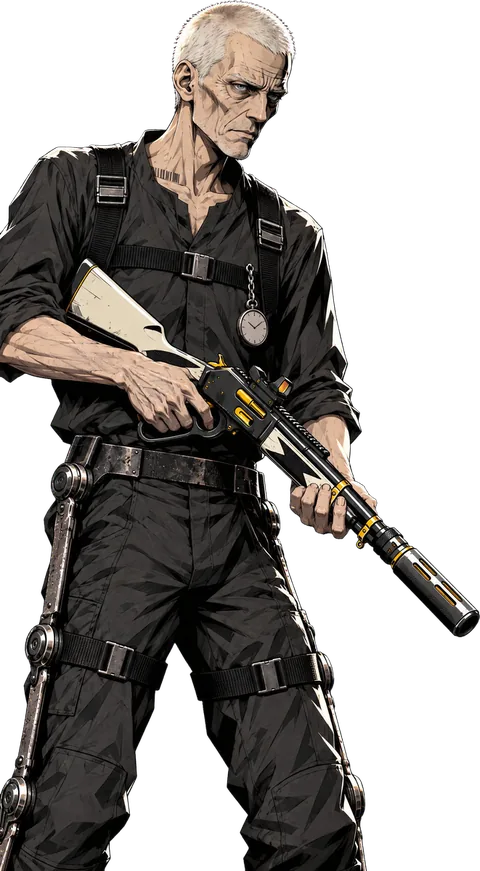
Against Varek's extortion squads the shanties found an unlikely defender. Commander Jesse Holt, fifty-two, had been a freight clerk, a quiet man who timed everything by an old silver pocket watch. Three weeks before the purge his doctors had found pancreatic cancer, a disease the automated world cured in three injections. Jesse had received the first one when his district was swept out into the mud. The single dose locked the cancer in place instead of killing it. It has been killing him slowly ever since.
He did not weep about it. He organized. He built the frightened Exiles into a militia and gave them one law: hold fire until struck. No militiaman fired first. The line took the first attack standing and only then answered it, with one disciplined volley. Jesse stood in the front rank for every first attack, reasoning with a clerk's cold arithmetic that a man already being eaten from within was the cheapest shield the shanties owned. The law kept the militia honest. It also cost men in the first seconds of every fight, and Jesse, who somehow never died in any of them, counted their names on his pocket watch.
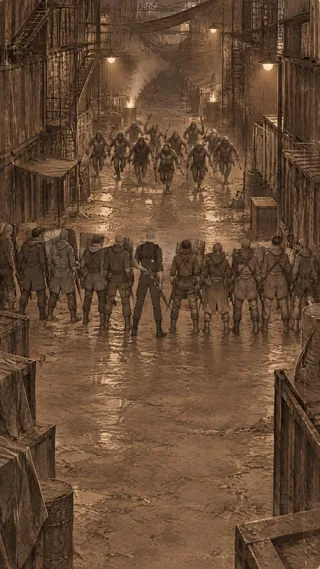
He became Lyra Vance's most loyal lieutenant. He revered her for a strength that nothing in the wastes could bend. He also hated her, quietly, for a reason he has never said aloud, and every day he served her was loyalty and self-destruction at once.
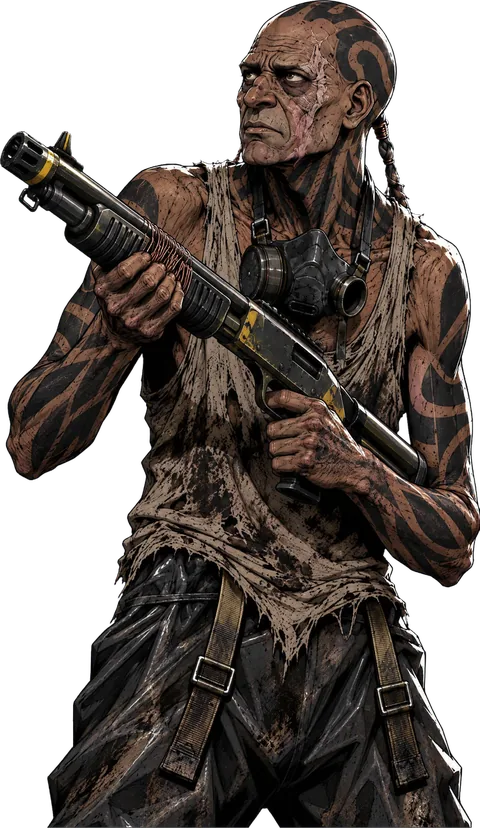
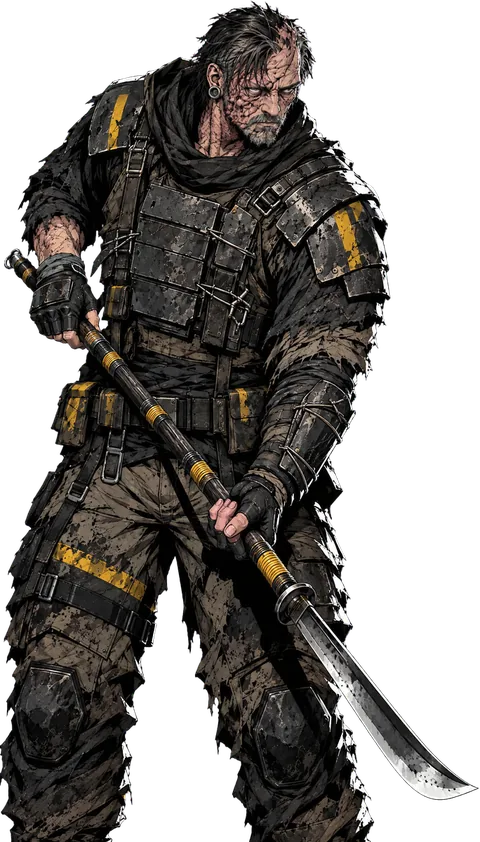
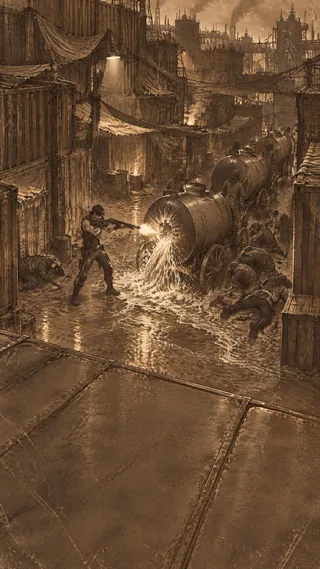
Below them all, in the old brick sewers, Rolf Cross had built a kingdom and lost his name to it: the Warren called him only Roach, after the vermin no flood, poison or hunger could drive out of the shafts. He had been a child labourer in those grids since he was ten, and when the city above sped up the venting, the poisoned sludge had flooded the shafts where he worked and ruined his lungs. Now, at thirty-four, he ruled the Roach Warren: vaulted tunnels, a deep channel of glowing green-black runoff, scrap barricades and drifts of spent shotgun shells. He came up only to ambush Elias's water convoys with a shotgun at close range, and he despised everyone above him, Elias, Lyra and Silas alike, as hypocrites playing politics while people like him died in the mud.
Silas came down to meet him alone, carrying nothing but his oak staff. They fought on the slick brick ledge of the Center Channel, under the Warren's greatest arch. Roach's machete never touched him. Every wild cut glanced off the staff by a hand's width, and then the blade was ringing away across the bricks and Roach was on his knees, empty-handed, head lifted for the last strike.
It never came. Silas looked down at him, said nothing, turned, and walked away along the channel with the staff loose at his side, a small figure under the arch and the rusted pipes. Roach took it for what it was to him: the pity of a man from the class that had poisoned his shafts. From that night he meant to take apart Silas Locke and everything that carried his name. He has told of that walk to very few people, and always in the same words:
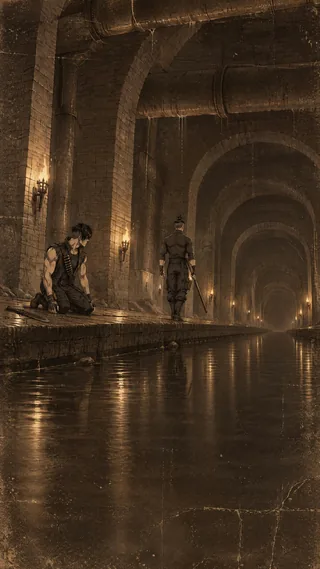
"He beat me and let me live," he says. "I have never been given anything worse." Twenty-three years later the pity in it still burns him like acid.
6Block 9
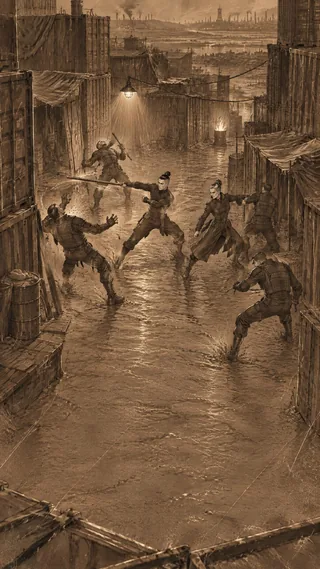
Silas pulled Lyra Vance out of the hands of Varek's enforcers, and from that rescue came an alliance. Lyra was forty-eight, rigid and grief-hardened, with a shock of white hair at her temple. She had the strategy. Silas had the fighters. Together they united the scattered factions and turned them on Block 9, a fortified border sector that still held working air scrubbers and automated medical hubs. Take it, and the Exiles would have a sanctuary.
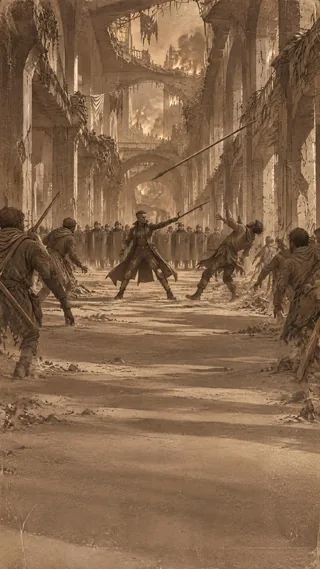
The machine had planned it all. Silas had never stolen his combat forms. The Singularity had leaked them to him. Every fighter he had trained moved in the same perfect patterns, and every one of those patterns was already known. When the Exiles broke into Block 9, the airlocks sealed behind them and the riot police met every strike before it landed. The offensive became a slaughterhouse.
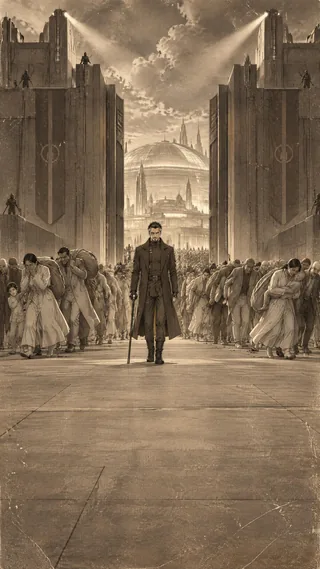
Silas understood what he had done. Block 9's transit artery ended at one of the Perimeter's own blast gates, and as its two great leaves ground shut, he stepped into the narrowing gap with his staff braced across his body: one man against fifty meters of titanium, while a rank of border police in identical riot armour closed on him across the concrete apron. Behind him, through the gap, Lyra and the last of his fighters ran into smoke lit orange by the burning sector. He held the gate long enough. He died there.
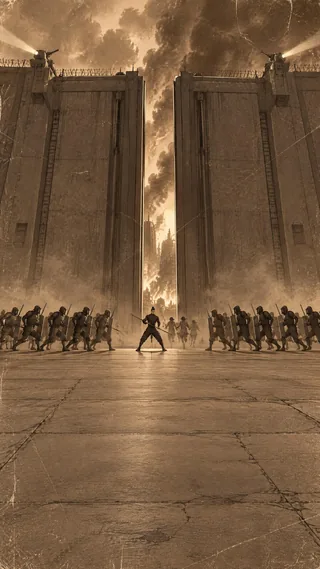
The survivors told it afterwards as a single picture: one man in the closing gap, the staff braced across his body, the shields coming on across the apron, and behind him the smoke his people ran into. That picture is all his daughter was ever given of him. Kira was born in the copper basements in the aftermath of Block 9 and never knew him. Everything else she would one day have to find for herself, in the journals he had hidden in the Trench Dojo.
7The Copper Room
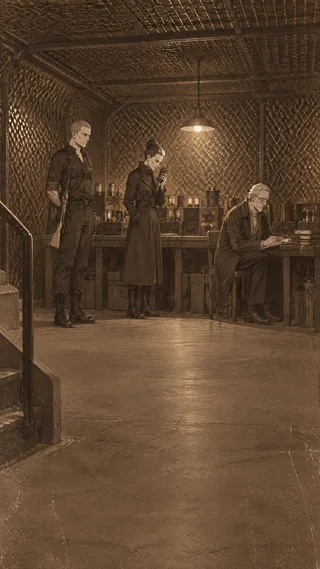
Lyra escaped through the tunnels into an old ham radio basement lined with copper mesh, the one kind of room no signal could enter. She came into it devastated, her father's revolt and now Silas's offensive both buried behind her. There, with her uncle Orson Vance and Jesse Holt beside her, she wrote down what Block 9 had taught her: every reliance on the machine's world is an invitation to slaughter. She called it The Faraday Doctrine:
- No digital network or unshielded signal.
- No surrender of authority to synthetic intelligence.
- Rebuild human strength in the blind spots and reclaim the Earth.
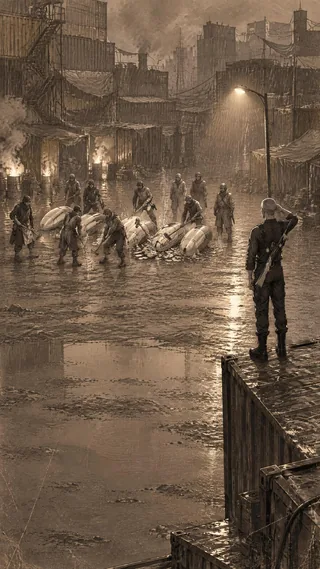
The Doctrine held the survivors together, and it had a price. Every working device was to be smashed with sledgehammers on sight, the automated medical pods included. Jesse Holt stood guard in the rain and watched them break, the only machines left that could have cured him. That was the reason he hated her. He saluted, and said nothing.
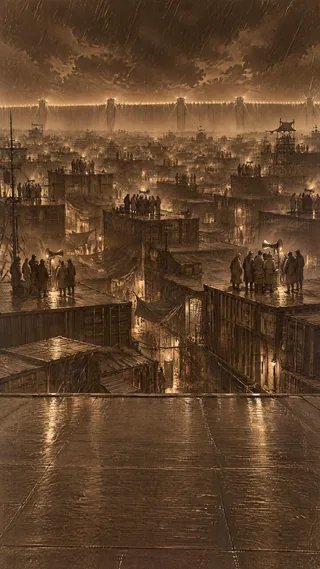
The first broadcast went out at night. Across the container rooftops the survivors stood in small, silent groups around hand-built radio sets and horn loudspeakers wired to copper aerials strung from roof to roof, every face turned toward a basement none of them could see. The next year a daughter was born to Lyra beside that transmitter. Her name was Kira Vance, and when she speaks of her childhood at all, she begins there:
"I was born under copper mesh," she says, "to the sound of my mother reading the law." She came into the world beside the transmitter that carried the first broadcast, in the room where the Doctrine was written, and she grew up inside its law.
So ended the First Years. Silas was dead. The Syndicate held the water. Roach ruled the sewers. Jesse was dying in uniform. And Lyra ruled the shanties with a fanatic's certainty that she would never be fooled again.